06 March 2006

Mercy Begets Mercy

At today's Mass, the Gospel reading was the Last Judgment scene where Our Lord interrogates both the blessed and the cursed. The questions revolve around the works of mercy they have (blessed) or have not (cursed) done. The grounding for these works of mercy is the Lord's mercy toward us. In fact, it is His mercy that produces in us mercy toward others. Therefore, for the homily, I chose a selection from St Peter Chrysologus where he ties together Ps 111.2 and Ps 145.9.

Here is a salient portion from that homily:

The prophet runs totally to [the Lord's] mercy, because he did not have any confidence in his own righteousness. "Have mercy on me, God," he says, "according to your great mercy." (Ps 51.1) And why it is great? "Because your mercy," he says, "is great towards me, and you have plucked my soul from the depths of the underworld." (Ps 86.13) And if God restores through mercy what had utterly perished through judgment, what, oh man, were you imagining would stand, would stand firm for you without mercy? (Sermon 42, "A Second [Sermon] on Fasting" in The Fathers of the Church, 109.171-172)

05 March 2006

Enter the Feast with Clean Bodies and Souls

In the Western Divine Office, according to the pre-Vatican II breviary reordered by Pope Pius X, at Matins there are 3 groups of 3 Psalms. On Sundays and major feasts, a lesson is read after each group of 3 Psalms. These lessons come from the Scriptures and the early fathers. The third lesson is always a commentary on the Gospel at the day's Mass. Today's first lesson was an expansion of the epistle at the Mass. The second lesson was a commentary by St Leo the Great. The entire sermon is worthy of your attention, but I would simply like to highlight the portion that struck me.

There is never any day or time which is not rich with divine gifts ; and always God's mercy is made available to us by his grace. Yet that is a reason why at the time of this great fast the hearts of all men should be moved to more earnest pursuit of things spiritual, and stirred up to complete trust in God. For now is drawing near the anniversary of the Day of our Redemption, which doth summon us to perform every duty of devotion, to the end that we may be able to celebrate, with clean bodies and souls, those mysteries which exceed all others, to wit, those of the Lord's Passion.

Mysteries so great demand a perseverance in devotion, and an abiding reverence, that so what we attain to be on the Feast of Easter, we may ever afterwards in God's sight continue to be. But few have the strength to do this, for the flesh in its weakness rebelleth against such hardness, and the business of this life doth distract us with many cares, whereby the hearts even of the godly are often smudged with the grime of this world. To the end that our souls may be restored to us in purity, there hath been provided for us, by a most wholesome custom in the following of Christ's example, the discipline of these forty days, wherein by godly works we may redeem the time which we have mis-spent, and by holy fasting may cleanse us of our faults. (Source)

We Are Wild Beasts

An excerpt from today's sermon:

To turn our heads and our hearts away from this false love; to expose the devil and his lies so that we see the true ugliness beneath the glossy veneer; and to release us from the inhuman love for death and the addiction of deep-seated self-hatred and loathing of all men—that is ultimately why Our Lord goes out into the wilderness. It’s not the devil He’s trying to impress. It’s the beasts.

Yes, the beasts. For St. Mark tells us that when Jesus was in the wilderness He was with the wild beasts. Now who are those beasts? They are not the demons. Rather, they are us. For when we give into our desires, when we greedily and hungrily feed our appetites, when we live only for ourselves and care for no man, when our whole life is consumed with consuming, when we are hurtful in word or deed, when we cannot exercise even the smallest amount of self-control—are we not then living like beasts in the wilderness? In fact, isn’t that the story of our life, ever since the Lord God sent Adam out of the garden? Hasn’t mankind lived the rest of his days in the wilderness, becoming more and more beastly with each successive generation?

The Father sees that this is our condition and it breaks His heart. And so in love, and out of the deepest canyons of His mercy, the Father by His Spirit sends His Son into the world. And today you’ve heard that the Spirit has now sent the Son of Man into the wilderness to be tempted by the devil so that He might win over and win back the wild beasts—that is, us and all mankind.
To receive the sermons, subscribe to ZIONNEWS.

04 March 2006

Scripture & Tradition II

No doubt, there are many readers to this blog who have heard of the Vicentian rule: Quod ubique, quod semper, quod ab omnibus ("that which is [held/believed] everywhere, always, by all"). It is named after St Vincent of Lerins who coined the phrase. It's really a take-off on St. Peter's rule; namely, "that no prophecy of Scripture is of any private interpretation" (2 Pt 1.20). Very simply, this means that your opinion of what the Bible means must be sacrificed in favor of the Church's consensus.

Such a rule is quite helpful, especially in the face of those who have nearly (or truly have) equalized sola Scriptura and nuda Scriptura. The first means that nothing of the Faith can contradict the Holy Scriptures, and that all teachings or doctrines must, in some way, be witnessed or attested to in the Scriptures. The latter phrase may be said (if a bit snidely) to be the "Bible, Bible, only Bible" rule.

I thought it might be helpful to produce the immediate context in which St Vincent of Lerins advances his rule; and why he comes to it. At least, I found this review of his writing to be most fascinating.

I have often then inquired earnestly and attentively of very many men eminent for sanctity and learning, how and by what sure and so to speak universal rule I may be able to distinguish the truth of Catholic faith from the falsehood of heretical pravity; and I have always, and in almost every instance, received an answer to this effect: That whether I or any one else should wish to detect the frauds and avoid the snares of heretics as they rise, and to continue sound and complete in the Catholic faith, we must, the Lord helping, fortify our own belief in two ways; first, by the authority of the Divine Law, and then, by the Tradition of the Catholic Church.

But here some one perhaps will ask, Since the canon of Scripture is complete, and sufficient of itself for everything, and more than sufficient, what need is there to join with it the authority of the Church's interpretation? For this reason,—because, owing to the depth of Holy Scripture, all do not accept it in one and the same sense, but one understands its words in one way, another in another; so that it seems to be capable of as many interpretations as there are interpreters. For Novatian expounds it one way, Sabellius another, Donatus another, Arius, Eunomius, Macedonius, another, Photinus, Apollinaris, Priscillian, another, Iovinian, Pelagius, Celestius, another, lastly, Nestorius another. Therefore, it is very necessary, on account of so great intricacies of such various error, that the rule for the right understanding of the prophets and apostles should be framed in accordance with the standard of Ecclesiastical and Catholic interpretation.

Moreover, in the Catholic Church itself, all possible care must be taken that we hold that faith which has been believed everywhere, always, by all. For that is truly and in the strictest sense "Catholic" which, as the name itself and the reason of the thing declare, comprehends all universally. This rule we shall observe if we follow universality, antiquity, consent. We shall follow universality if we confess that one faith to be true, which the whole Church throughout the world confesses; antiquity, if we in no wise depart from those interpretations which it is manifest were notoriously held by our holy ancestors and fathers; consent, in like manner, if in antiquity itself we adhere to the consentient definitions and determinations of all, or at the least of almost all priests and doctors. (Source)

Hearing, Yet Hearing?

In the Gospel at today's Mass, the disciples are caught alone in a boat during a storm. Our Lord sees them "straining at rowing," comes to them, acts as if He would walk right past them, and then comes to their aid after they have cried out to Him. Clearly He is testing their faith. And equally as clear, this Gospel beautifully contrasts how we (like the disciples) often cower in fear when temptation strikes during our Lenten fast; and how we should instead imitate Our Lord's example when He endured temptation during His Lenten fast (which we will hear about in tomorrow's Gospel).

However, the homily I read from St Bede the Venerable speaks not of us (individually) but of the Church. He says that the Church is the boat caught in the storm. And during these storms, says the saint, "Right well is it written that the ship was in the midst of the sea, and the Lord alone on the land. For sometimes the Church is not only sore pressed by the Gentiles, but also in such wise broken up that, if it were possible, it would seem for a time as though her Redeemer had abandoned her."

As I read (and heard) this venerable man, I considered what St Bede meant by "the Church" and "broken up." Surely he would not have thought as we think today. For our (Protestant) understanding of "the Church" is governed by the hermeneutic that the Church is primarily, if not exclusively, invisible. In other words, we hear the words "the Church" and we think not of a particular communion; i.e., an organic body which is concretely manifested by eucharistic fellowship between bishops or (if you must) congregations. Rather, we think of an amorphous, vague "thing" whose "communion" is not in eucharistic sharing but the shared belief of scattered believers (who may be found in various communions, often times despite their particular communion's prayed confession). In other words, we spiritualize "the Church" or, worse yet, noeticize it. For this reason, we think the "broken up"-ness of "the Church" has to do with the various denominations--all of which are imperfect because none have a pure confession (except, perhaps "us" who live within an heterodox or heretical communion).

Yet this is not St Bede's understanding of "the Church." In his day, the Church is a concrete organism. You can point to the eucharistic fellowship by pointing to the inter-communion between the bishops or churches. The "broken up"-ness, then, is not one which has to do with varities of confessions, or greater or lesser degrees of heresy/heterodoxy, among those who are not in communion with each other. Rather, for St Bede, the "broken up"-ness has to do with the weakness or pride of men (primarily the clergy) within the real communion who still actually confess the same Faith. In other words, the "broken up"-ness is not that some blatantly reject the Faith while calling themselves "true Christians," or change the Faith with self-chosen liturgies (editting out the things that don't seem to fit their thinking). Rather, the "broken up"-ness is that the Faith they hold is being weakly held; or that rigorism compels some to break communion for a while.

The point I'm making is twofold. First, because of our context (and our interpretive tradition), we hear both the Scriptures and the fathers vastly differently than their original, intended sense. And second, for the same reason, our understanding of the "broken up"-ness of "the Church" would be completely foreign to someone like St Bede the Venerable.

03 March 2006

St Jerome on Today's Gospel

Fasting without mercy is no fast. So says Our Lord in the Lesson at today's Mass. The Gospel continues the theme with Our Lord's mandate to love our enemies, and to give alms.

St Jerome's comment on the portion, "Love your enemies," I find to be quite striking. With a knife, he cuts away that part of us which would have us believe that we've done well not to hate our enemies. He also then directs us to true love--concluding with Our Lord's love for us in His prayer.

The Lord hath said unto us: Love your enemies; do good to them that hate you. Many there be who measure God's commandments by their own weakness, and not by the strength of his Saints; and so deem him to have commanded things impossible. Of such are they who think that the best they can do is not to hate their enemies; and that to command us to love them, is to command more than man's nature can bear. It behoveth them to know that Christ did not command to do what is impossible, but what is perfect. On this wise it was that David did, in respect to Saul and Absalom. And likewise, the Martyr Stephen prayed for his enemies, even while they were stoning him. And even so Paul could wish that himself, and not his persecutors, were accursed from Christ. On such wise Jesus both taught and did, when he said: Father, forgive them, for they know not what they do. (Source)

02 March 2006

St Peter Chrysologus Again

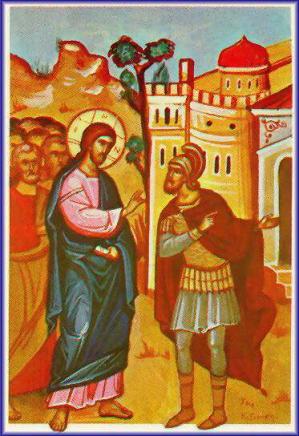
Each day of Lent has its own set of propers. Today's Gospel was the episode from St Matthew's Gospel of the centurion beseeching Jesus to heal his paralyzed servant. Here is a portion from a sermon on this text by St Peter Chrysologus.

[The centurion in effect says]: "I call him mine [i.e., my servant], because he is lying down; if he were yours, Lord, he would not be lying down. The prophet attests to this when he says, 'Come, now bless the Lord, all you servants of the Lord, who stand in the house of the Lord. (Ps 133[134].1) You who 'stand' [do] not 'lie down.' Your servants stand, the servants of human beings lie down. May my servant-boy who is lying down rise in order to be yours. He is mine because he is paralyzed; may he now be healed so as to be yours. He is mine because he is badly afflicted; so that he be yours, may be now be in no pain.

"Lord, it is not fitting for your servants to be subjected to evils. The pain of your servants is an injury to you. The force of evils should not take hold of your servants. Your servants, althought they suffer evils, do not suffer for punishment, but undergo them for crowns; for them adversities are not causes of distress, but causes of victory. Servants of human beings are the ones who suffer evils unwillingly, because their masters are unable to help them in their desperation. But you, O Lord, whom the powers serve, whom cures obey, to whom healing remedies submit, how will you regard him as your servant while you see that he is the slave of such diseases?

"Your goodness is known among the wicked, even the godless acknowledge your kindness, and outsiders proclaim your mercy: am I to say that he is yours, even though your benevolence does not seek him out as he lies ill? He lies at home and is badly afflicted. (Mt 8.5) And so, the magnitude of the affliction does not allow me to bring him and present him to you, lest the infirmity of the servant, if made public, cause him both pain and shame."

The centurion moved the Judge by making so great and heartfelt an appeal, and he was so effective that the Lord of heaven himself willed to go to his servant. I shall come, said Christ, and cure him. Brothers, the centurion did not coerce the Author of compassion to show compassion, nor did he compel Christ to go to that for which Christ had come; but rather the centurion is taught in this way to perceive and understand why Christ came to the servant in a servant, why God came to man in a man. Assuredly he came to raise the prostrate, to set back on their feet those who had been knocked down, to free those in shackles (see Ps 145[146].7-8), and, since he himself is the most kind bearer of his own creation, to carry those whom no one as yet was able to bring and present. (The source is the same as yesterday's citation, only pp. 71-72)

01 March 2006

"Oddest Thing" Tag

My good friend, Pr David Petersen, has tagged me wanting to know the oddest thing in my office. Now does this mean my officium to dispense the sacred mysteries, or the place where I read, write, smoke, etc.? I'll assume the latter.

If "oddest" means "strange item most commented upon," then it would have to be a grey metal old-fashioned key holder that holds up to 100 keys. It's plastered to the gorgeous inch-thick knotty pine panelling, and so sticks out like a sore thumb. It's a left over from my predecessor (and perhaps his predecessor) and is filled with keys for the "Zion campus." Most, I'm sure, no longer work--although one never knows...

I tag the guys at Beggers All.

St Peter Chrysologus on Fasting

On his blog, my friend, Fr William Weedon, likes to include a "Patristic Quote for the Day." He's received some FLieger Abwehr Kanone because his citations seem to favor Eastern rather than Western fathers (as if the two are in competition).

To lend him an assist, I post this quote from one of my favorite fathers (East or West)--St. Peter Chrysologus.

It is fever that the blessed Apostle laments is seething within human wounds, when he says, "I know that nothing good dwells in me, that is, in my flesh." (Rom 7.18) If nothing good, then certainly evil. What evil? Truly a certain frailty creeps within the flesh, seethes in the veins, enters the bones, is hidden in the marrow, boils within the blood, and thus bursts forth into a frenzy of vice. Frailty is the fever of nature, the mother of weakness, the source of passions. Frailty is that which places us under the law of compulsion; and where there is compulsion there is no free will, there is a condition of captivity, and one's judgment is irresolute and impotent.

It is on account of frailty that the human goes not where his will beckons, but where the compulsion leads. Listen to the Apostle as he says, "I do not do what I will." (Rom 7.15) Frailty, while it deals with the things necessary for the human being, causes him to reach for what is unnecessary; while it provides food, it leads to gluttony; it offers sleep in order to hand over laziness; it increases one's concerns for the belly, in order to remove any concern for health [salus; i.e., salvation]; it gives everything to the flesh, in order to leave nothing for the soul; it makes the body the showplace of the passions; it causes the human being to be the death of himself and the life of the vices.

Therefore, if a person feels that he is sick in this fashion, let him submit himself to the heavenly Physician, let him feel safe in acceding to his directives, let him be temperate when it comes to food, let him keep some for later, so that in this way he may be able to overcome the weakness of frailty, flee from frailty, and transform the fever of the passions and the frenzy of vice.

Abstinence is the first medicine the human being must take, but for a complete cure the expenditure of mercy is required. (Sermon 41 "On Fasting" in The Fathers of the Church, vol 109.164-165)

Original Fasting

Consider this: When Our Father commanded Adam and Eve not to eat from the Tree of the Knowledge of Good and Evil, He was commanding them to fast. For fasting is not simply the disciplining of our flesh, but also submission to Our Lord's command. True obedience is true trust.

Yet Adam and Eve did not obey. Which means, they did not trust the Lord and submit to His Word. And that was shown in their refusal to fast. And by refusing to fast, they lost the Garden and all that He made for them.

So our first parents lost their way when they indulged their appetite and gratified their flesh. Had they only fasted from that tree as Our Lord commanded, they would not have run from Him in fear. Had they only fasted from that forbidden fruit, they would not have stood naked and ashamed before God and the world. Had they only fasted from the devilish enticement to live as they please, they would never have lived to die.

Perhaps this is why Jesus doesn't suggest we fast. He doesn't say, "Should you fast" or "If, perchance, you happen to fast" or "If you wish to fast." Instead, He says, "When you fast." And so Our Lord bids, commands and directs us to fast.

But which fast should we follow. Again, consider Adam and Eve. If their self-chosen diet led to our downfall, then it stands to reason that our self-chosen fasts will not lead us closer but further from the kingdom. And if that's the case, then perhaps this Lent we should not simply "give something up"--something that we've deemed worthy of sacrificing. Perhaps, instead, we should submit to the church's fast.

Now the church has many fasting traditions--even during Lent. And just as your doctor knows which prescription is best for you, an attentive caring priest or pastor or spiritual father should be able to prescribe a fast that is well-suited to your spiritual condition.

So here's the point--no self-chosen fasts this Lent. Rather, submit yourself to whatever fast you are given.

For you see, in the end, fasting really is simply a matter of submission and trust. And it is given by the Lord through His Church not as punishment or repayment, but so that you don't lose out the golden fruit of the Tree of Life.