25 October 2006

Three Remedies from St Raphael

Yesterday when I celebrated the Feast of St Raphael the Archangel, I read these words from St Bonaventure. Granted, he is a post-schismatic medievalist's medievalist; nevertheless, I found what he wrote very comforting. Below are excerpts, but I encourage you to read the whole of what the breviary provides.

Raphael by interpretation is : The Medicine of God. Consider therefore the three remedies bestowed upon us by Raphael which are, as it were, medicines to heal our sickness. First of all Raphael the physician would deliver us from infirmity of soul by inducing within us the bitterness of contrition. This is attested by the Book of Tobit, where we read how Raphael telleth Tobias to anoint his father's eyes with gall ; and how, when it was done, Tobit did see. Could not Raphael have done the anointing himself? Nay, for an Angel cannot give repentance, but only shew the way thither. ...

Secondly, Raphael would deliver us from the devil's bondage by putting us in remembrance of the passion of Christ. ...

Thirdly Raphael would deliver us from the wrath of God, incurred by sinning against him, and this he would do by inducing in us greater earnestness in prayer. Consider how the Angel Raphael, according to Chapter twelve of the Book of Tobit, said : When thou didst pray, I did bring the remembrance thereof before the Holy One. For in such fashion the Angels do all that they can to reconcile us to God. The devils are the fallen angels who accuse us before God. But the holy Angels excuse us, namely, when they bring before God those prayers which they have already stirred us up to offer more devoutly. ...

13 October 2006

My Season of Silence...

To every thing there is a season, and a time for every purpose under the heaven:

a time to be born, and a time to die;
a time to plant, and a time to pluck up that which is planted;
a time to kill, and a time to heal;
a time to break down, and a time to build up;
a time to weep, and a time to laugh;
a time to mourn, and a time to dance;
a time to cast away stones, and a time to gather stones together;
a time to embrace, and a time to refrain from embracing;
a time to get, and a time to lose;
a time to keep, and a time to cast away;
a time to rend, and a time to sew;
a time to keep silence, and a time to speak;
a time to love, and a time to hate; a time of war, and a time of peace.


Ecclesiastes 3.1-8

26 August 2006

True Faith & True Humility

Humility and faith go together. To trust is to set aside your pride—that you know best, that you have all the answers, and that you can work things out on your own. And to be humble is to believe that you are no better than others, and that you need and depend on them.

“I don’t deserve your love, your kindness, your generosity or anything that God gives me through you.” That’s what the truly humble say. It’s also what the faithful man says. For the person of faith acknowledges that anything he offers or does or gives is meager and paltry and not worthy to be compared with whatever the Lord gives through His ministers and through others. And the humble man confesses that, apart from the Lord, everything he does is worthless and vain.

It takes great humility to say, “I was wrong. I mistreated you. I abused our friendship. I am not worthy to stand in your sight.” It also takes great faith. For when you confess your sin, you are not only humbling and lowering yourself; you are also trusting that your apology will be accepted, your sincerity will be believed, your words will not be swatted aside, and your admission will not be used against you.

When you make excuses or defend yourself or blame others or demand special treatment or—worse yet—trot out the good you’ve done, then your pride has stomped out humility; and your faith has been overrun by self-belief. And the man who believes in himself has turned his eyes away from the Lord, and has spurned the Lord’s mercy.

But the man who has true faith and true humility demands nothing from God or anyone else. Of all the things he could request, he begs for only one thing—not life, not strength, not resolve or willpower, but mercy. God, be merciful to me, the sinner. That is his only prayer—that his Creator have mercy on him; that his Savior pity him; and that the Spirit breathe into him once more the faintest whisper of God’s undying compassion. And in return, this man of faith and humility offers nothing except his entire being—all that he is and all that he has--to God for the good of all men. Such an offer he makes, not to buy God’s affection, but knowing that all he has is not his own, but the Lord’s—which he has only tainted or ruined or abused or wasted by his prodigal living. And so “mercy” is his only prayer. And “have mercy” is his gasping breath.

This is a faithful saying and worthy of all acceptance: that Christ Jesus came into the world to save sinners, of whom I am chief. And so this man, who truly knows himself, is not too proud to stand with the heathen and make a mess of himself in God’s house. This man is humble because he believes; and he believes because he is humble. And so this man went down to his house justified rather than the other; for everyone who exalts himself will be humbled, and he who humbles himself will be exalted.

19 August 2006

Too Funny to Pass Up

Acknowledgement

The Devil's Day vs. The Lord's Day

We must be on guard that we live not for this day, this moment, this time, but that we live for the Lord’s Day. For the devil has his day—and he can easily seduce us to believe that his day is the best day. How does he do this? Whenever we live for earthly gain or fleeting pleasures; whenever we agree with the Truth but pursue compromise for the sake of peace; whenever we look for honor and praise; whenever we place convenience ahead of living the Lord’s Word; whenever we feed our appetites and gratify our desires; whenever we tolerate false teaching by remaining in communion with it—then the devil is successfully luring us into his day, seducing us to prefer his day over the Lord’s Day. However, the Lord’s Day—both now at Holy Mass, and eternally in the heavenly kingdom—that is the day we must live for, the day we must fix our eyes upon, the day we must desire more than any days that we find comfortable. And for the sake of this eternal day, we must be willing to forsake all our self-chosen days.

The soul that gives itself over to present affairs, the soul that melts at the prospect of earthly comforts or peace at the expense of truth—that soul has hidden the coming evils from itself. It shrinks from anticipating future things which might disturb its present happiness. And when it abandons itself to the delights of the present life, what else is it doing but rushing headlong into the fire with eyes closed? So if there is any happiness that we may derive during these days, let us always temper that happiness with a clear vision of what will be—with true fear of the judgment to come, and true faith in the greatest joys and pleasures that Our Lord has stored up for us, and even now permits us to taste in His holy sacraments.

Our Lord provides us with His mercy in the sacred mysteries. He does this precisely so that we might not deviate from the Way that He is, so that we don’t lose His Way by going our own way. Our Lord extends to us, time and again, His strength and His might in the Eucharist so that we might withstand the seductions of the devil, and so that we might live not for this day but for His Day. In fact, with St Gregory, we may say that Our Lord uses His Gospel in Sacraments and bishops as obstacles to block our self-chosen way. For you have heard that when you go [your way] with your adversary to the magistrate, while you are on the way, endeavor to be delivered from him (Lk 12.58). Our adversary on the way is God’s word, which is contrary to our physical desires in this present life. One who submits humbly to His commandments is delivered from this adversary. So by surrendering your self-serving pride and your self interests and, instead, living the Lord’s mercy, you both make this godly “adversary” your greatest friend, and you abandon your self-destructive way in favor of the Lord’s highway into His kingdom.

An excerpt from tomorrow's sermon. The portions in green are from Homily 39 in Forty Gospel Homilies of St Gregory the Great.

18 August 2006

So Close, So Beautiful

I would like to think that Zion Detroit is the ecclesial jewel in the city, but there are many others. I'm not sure any Detroit parish could exceed the liturgical and ceremonial of Assumption Grotto on the celebration of its titular feast. To show you what I mean, visit their blog and view the 4 photo posts. Stunning!

BT - New Liturgical Movement

17 August 2006

Mercy -- Even for Those Who Insult You

Many church fathers, commentators, preachers--both within the boundaries of the holy Church and outside those boundaries--have maintained that the Lord's commandments to "love one another" and "love your enemies" and "be merciful" may be difficult, but they are not impossibe. For Our Lord does not demand the impossible. But He does require that we submerge our passions of anger, hatred, grudge-bearing, and refusal to forgive and instead embrace all men--especially those who have insulted us or wronged us or treated us ungratefully, unkindly, or unlovingly.

And to show us both that this is not an impossible demand, and that He can and will live His love in and through us, Our Lord leaves us an example when He enters the holy temple during His last month. To be sure, Our Lord drives out those who "buy and sell." But observe the mercy, as drawn forth by St Gregory the Great.

There is no doubt that those who resided in the temple to receive gifts sought to do harm to those who did not give anything. The house of prayer had become a robbers’ den because it was known that those assisting in the temple were there either to do physical harm to those who did not offer gifts, or to inflict spiritual death on those who did. But our Redeemer does not take His preaching away from those who are unworthy and ungrateful. After demonstrating the power of His discipline by driving out those in error, He straightway showed the gift of His grace. [For] He was teaching daily in the temple.

Source

15 August 2006

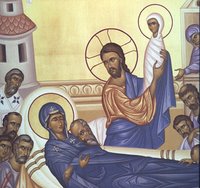
From Her We Have Plucked the Fruit of Life

The following is a condensed version of a sermon by St John of Damascus on the Dormition of the Blessed Virgin Mary. It was preached this morning at the Dormition Mass at Zion Evangelical-Lutheran Church of Detroit.

No one who has ever lived, and who lives now, is able to praise worthily the holy death of Mother of God because she is greater than all praise. Nevertheless, since it is pleasing and acceptable to God that we should, as best we can, honor her with all our heart and love and zeal, and since what is pleasing to her Son is pleasing to His mother, let me make a feeble attempt to praise the Mother of our God and Lord, Jesus Christ. To do this, I invoke the Word made flesh in the womb of the blessed Mary. May He assist me, for He gives speech to every mouth which is opened for Him, and He is her sole pleasure and adornment.

Today the holy Virgin of Virgins is presented in the heavenly temple. Virginity in her was so strong as to be a consuming fire. It is forfeited in every case by child-birth. But she is ever virgin: before the event, in the birth itself, and afterwards.

Today the sacred and living ark of the living God, who conceived her Creator Himself, takes up her abode in the temple of God, not made by hands. David, her forefather, rejoices. Angels and Archangels are in jubilation, Powers exult, Principalities and Dominations, Virtues and Thrones are in gladness: Cherubim and Seraphim magnify God. Not the least of their Praise is it to refer praise to the Mother of glory.

Today the holy dove, the pure and guileless soul, sanctified by the Holy Spirit, putting off the ark of her body, the life-giving receptacle of Our Lord, found rest to the soles of her feet, taking her flight to the spiritual world, and dwelling securely in the sinless country above.

Today the Eden of the New Adam welcomes its true paradise, in whom our sentence has been repealed. For in her the Tree of Life was planted, and our nakedness is covered. For we are no longer naked and uncovered, and unable to bear the splendor of the divine likeness. Strengthened with the abundant grace of the Spirit, we shall no longer lament our nakedness saying, “I have Put off my garment, how shall I put it on?” For in this Paradise, this woman, the serpent found no entrance. He could not deceive her with the promise to be like God. For the only begotten Son of God, God himself, of the same substance as the Father, took His human nature of the pure Virgin. Because of this—because of His coming down into Mary’s womb, and her willingness to receive Him—we, who are men, can become God; we, who are mortal, are made immortal; and we, who are corruptible, can now in the Spirit put aside corruption and be clothed in the garment of divinity.

Today the spotless Virgin, untouched by earthly affections, and all heavenly in her thoughts, was not dissolved in earth, but truly entered heaven to dwell in the heavenly tabernacles. Who would be wrong to call her heaven, unless indeed he truly said that she is greater than heaven in surpassing dignity? With her womb, the Lord and Creator of heaven, created Himself, without the aid of a man. He made her a rich treasure-house of His Godhead. He resided in her entirely without passion. Now how could she, who brought life to all, be under the dominion of death? Yet she obeys the law of her own Son, and inherits this chastisement as a daughter of the first Adam, since her Son, who is the life, did not refuse it. As the Mother of the living God, she goes through death to Him.

O people of Christ, let us then acclaim her today in sacred song. Let us acknowledge our own good fortune and proclaim it. Let us delight in her purity of soul and body, for next to God, she surpasses all in purity. It is natural for similar things to glory in each other. Let us show our love for her by compassion and kindness towards the poor. For if mercy is the best worship of God, who will refuse to show His Mother devotion in the same way? She opened to us the unspeakable abyss of God’s love for us. Through her the old enmity against the Creator is destroyed. Through her our reconciliation with Him is strengthened, peace and grace are given to us, men are the companions of angels, and we, who were in dishonor, are made the children of God. From her we have plucked the fruit of 1ife. From her we have received the seed of immortality. She is the channel of all our goods. In her God was man and man was God. What is more marvelous or more blessed?

Therefore, let our souls rejoice in this Ark of God. Let us dance in spirit with David; today the Ark of God is at rest. With Gabriel, the great archangel, let us exclaim, “Hail, full of grace, the Lord is with thee. Hail, inexhaustible ocean of grace. Hail, sole refuge in grief. Hail, cure of hearts. Hail, through whom death is expelled and life is installed.”


You will find the full sermon here, which also served as the original source. An eye was also on another translation of the same sermon found in volume 4 of The Sunday Sermons of the Great Fathers.

10 August 2006

Reed Organ

This is a "must share" and a "must see." It is a short (about 3 minute) video of an original hand-pump reed organ.

Thanks to Jeffrey Tucker at New Liturgical Movement.